-
30 Sep 2026
-
For Hybrid & Remote Teams
-
7 min Read
Beyond the Boardroom: Why Hybrid and Remote Teams Desperately Need In-Person Days
Hybrid and remote work are here to stay — and for good reason. No traffic on the N1, more time with family, and the focus to do deep work without interruptions. But ask most hybrid teams how connected they feel to colleagues outside their immediate circle, and the answer is often a shrug.
Video calls are excellent for getting through an agenda. They are far less effective at the things that make teams work well over the long term: trust, spontaneous ideas, and the sense that everyone is on the same side. Those still happen best when people share the same physical space.
This article looks at why screen-based teams drift apart, how “proximity bias” quietly creates two classes of employee, and how to plan an in-person offsite day that’s worth the drive.
You can run a meeting on a screen. You can’t build a team on one.
SA Teambuilding
Video-call fatigue is real — and it has causes
That drained feeling after a day of back-to-back video calls isn’t in your head. Researchers at Stanford University’s Virtual Human Interaction Lab identified four reasons video meetings are so tiring:
-
Constant close-up eye contact: large faces staring at you from close range feel intense in a way a normal meeting room doesn’t.
-
Seeing yourself all day: looking at your own face for hours is unnatural and makes people more self-critical.
-
Staying in one spot: you have to stay in the camera frame, so you move far less than you normally would.
-
Extra mental effort: body language that happens naturally in person has to be worked at on a screen — and read from tiny, delayed signals.
The result is a workforce that is productive on paper but tired, and increasingly reluctant to use video for anything beyond the essentials. That’s exactly where relationships start to thin out.
What gets lost when everything happens on a screen
Online meetings are scheduled, structured and focused on a task. That’s efficient — but it squeezes out the unplanned moments where much of a team’s real value is created: the quick question at the coffee machine, the idea sketched on a whiteboard, the chat with someone from another department that solves a problem nobody had raised yet.
Microsoft’s Work Trend Index found that about half of hybrid and remote workers (51%) said their relationships outside their immediate team had weakened, and 43% felt disconnected from their company as a whole. Those wider relationships are exactly what creative problem-solving depends on — new ideas usually come from connecting people and knowledge that don’t normally meet.
Trust suffers too. It’s built through small, repeated signals — seeing how someone reacts under pressure, sharing a laugh, helping each other out. On a screen, most of those signals simply never happen.
Proximity bias: the hidden problem in hybrid teams
Proximity bias is our natural tendency to favour the people we physically see most often. In a hybrid company it can mean that employees who are in the office more get noticed more, get included in more informal conversations, and are more likely to be thought of first for projects and promotions — even when remote colleagues are doing equally good work.
Nobody sets out to be unfair. But over time proximity bias can create an “in-group” and an “out-group”, which is a fast route to frustration and resignations among your remote staff.
A shared in-person day is one of the simplest ways to level the playing field. When everyone is in the same place, facing the same challenge, there is no mute button, no bad connection and no “on-site team” versus “remote team”. The quiet developer from Durban gets the same chance to shine as the manager who sits next to the CEO — and leaders get to see strengths they would never spot on a video call.
How to make the most of a quarterly or bi-annual offsite
Microsoft’s research found that 73% of employees want a better reason to come into the office than “because the company expects it” — and 85% said rebuilding team bonds would motivate them. So give people a reason. A quarterly or twice-yearly offsite works well for most hybrid teams. To get the most out of it:
-
Don’t fill it with presentations. Anything that could be an email or a video call should be. Use the day for what only works in person.
-
Start with energy, then get to strategy. A high-energy team activity in the morning breaks the ice, so the afternoon planning session is more open and honest.
-
Mix people up on purpose. Build teams across departments, locations and seniority levels so people meet colleagues they only know from email.
-
Make it easy for remote staff to attend. Budget for travel, and pick a date and venue that suit people from outside your main office.
-
Leave time for unstructured conversation. Lunch, a braai or sundowners are where many of the most valuable connections happen.
-
Keep the momentum going. Agree on one or two cross-team actions before everyone goes home, and follow up on them at the next virtual all-hands.
A sample offsite day
-
08:30 – Arrival and coffee: time to catch up informally, with mixed name-tag groups already assigned.
-
09:00 – High-energy team challenge: a facilitated activity in mixed teams to break down barriers quickly.
-
12:00 – Lunch together: no agenda, no laptops.
-
13:30 – Strategy or problem-solving session: the work that genuinely benefits from everyone being in one room.
-
15:30 – Commitments and wrap-up: agree on next steps and who owns them.
-
16:00 – Social time: drinks or a relaxed evening event for those who can stay.
Programmes that break down digital silos fast
When a team only sees each other a few times a year, you don’t have time for a slow warm-up. The best in-person activities for hybrid teams are high-energy, collaborative and impossible to do on autopilot:
-
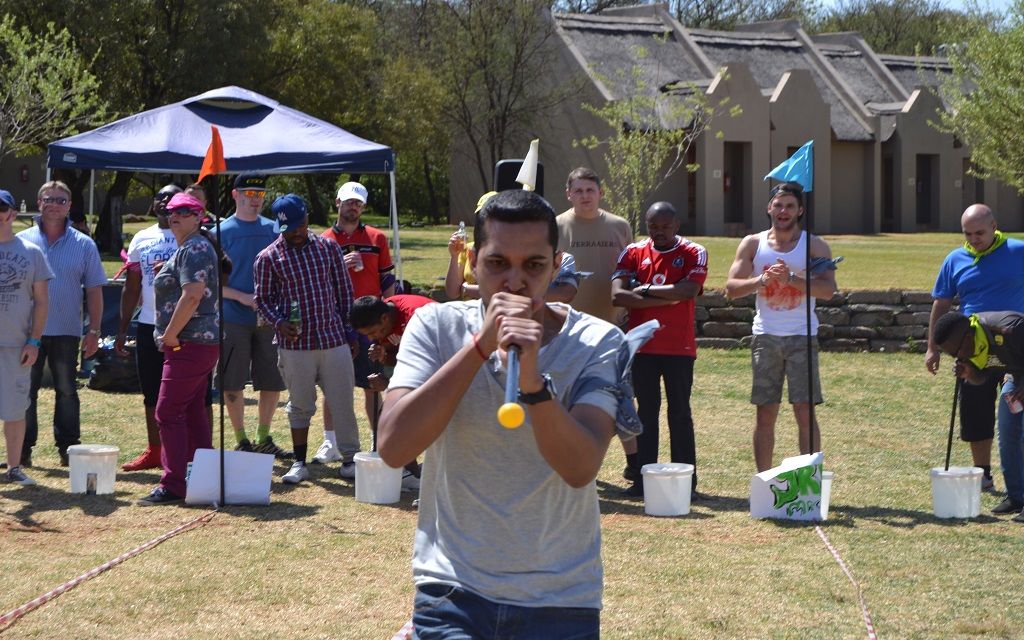
Wild & Wacky Olympics: relay races, inflatable sumo and outrageous games suitable for all fitness levels. It’s hard to stay formal with someone after you’ve raced them in a human wheelbarrow — the laughter does the ice-breaking for you.
-
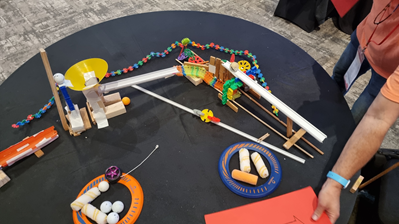
Chain Reaction: teams build a giant Rube Goldberg machine where every piece has to trigger the next. One weak link stops the whole chain, so people have to communicate across teams — exactly the skill hybrid teams need back at work.
-
Amazing Race and Mobile Escape Room: problem-solving under time pressure that rewards every kind of thinker, not just the loudest voice in the room.