-
30 Sep 2026
-
For Managers & Team Leads
-
7 min Read
Gamifying Company Culture: Why “Play” is the Secret Weapon for Problem-Solving
Ask a room of managers how their teams come up with their best ideas and you’ll rarely hear “in the quarterly strategy meeting”. Breakthroughs tend to happen when people are relaxed, curious and a little bit competitive — in other words, when they’re playing.
Play has an image problem at work. It sounds like the opposite of productivity. But research on how adults learn, remember and collaborate points the other way: well-designed play is one of the fastest ways to build the habits teams need when the pressure is real — clear communication, quick decisions and trust in each other.
Here’s what the science says, why low-stakes competition prepares teams for high-stakes moments, and how you can bring more play into your team meetings starting this week.
Teams don’t rise to the occasion under pressure. They fall back on what they’ve practised — so practise together where the stakes are low.
SA Teambuilding
Why adults learn better when they’re doing, not listening
Most corporate training still looks like a lecture: someone talks, everyone else listens. The evidence for that approach isn’t great. A major 2014 analysis of 225 studies, published in the Proceedings of the National Academy of Sciences, found that students in traditional lecture-based classes were 1.5 times more likely to fail than those in classes built around active, hands-on learning.
That research was done in university science courses, but the principle carries over to the workplace. People remember what they figure out for themselves far better than what they’re told. A game forces everyone to take part, make decisions and see the results straight away — exactly the conditions in which lessons stick.
The brain science: curiosity, dopamine and memory
Good games are built on curiosity — “What’s behind the next clue?”, “Can we beat the other team?”. That feeling isn’t just pleasant; it changes how the brain stores information.
-
Curiosity activates the reward system. A 2014 study at the University of California, Davis found that when people were curious, the brain’s dopamine-driven reward circuit became more active.
-
It boosts the brain’s memory centre. The same study saw greater activity in the hippocampus, the area that forms new memories, and stronger links between it and the reward circuit.
-
Everything around the moment is remembered better. Curious participants even remembered unrelated information they saw during that time better — and still did a day later.
For managers, the takeaway is simple: when a team is engaged and curious, it doesn’t just enjoy the session more — it remembers more of what happened, including the lessons about how it worked together.
Low stakes today, better decisions under pressure tomorrow
When Google studied what made its most effective teams different, it found that psychological safety — people feeling safe to speak up, take risks and admit mistakes without being embarrassed — mattered more than anything else.
Games are one of the easiest ways to build that safety. When the only thing at stake is bragging rights, people are willing to suggest the wild idea, try something and get it wrong, or tell the manager their plan won’t work. Those habits carry straight back to the office.
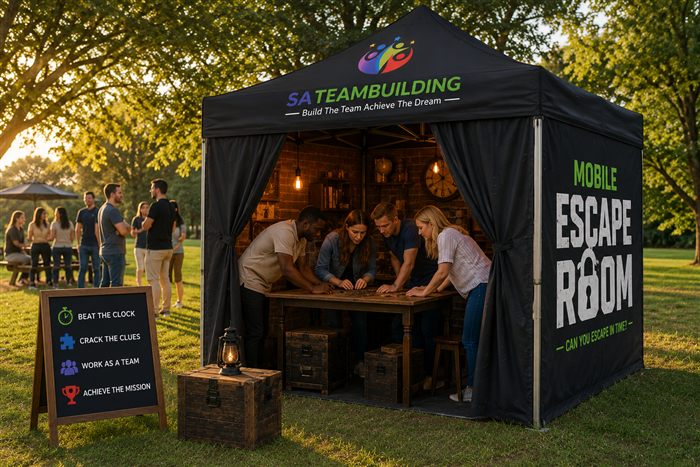
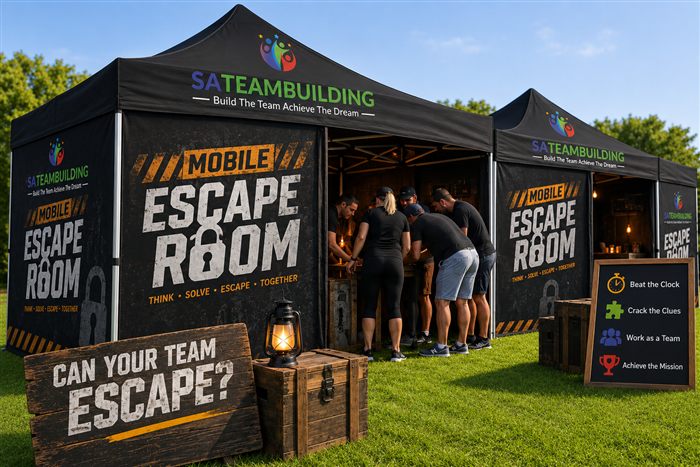
Immersive challenges also give teams a safe rehearsal for stressful situations. In a Mobile Escape Room, for example, teams race the clock, juggle incomplete information and divide up tasks on the fly — much like a client crisis or a tight deadline. The difference is that when the timer runs out, everyone laughs, talks about what went wrong, and learns from it together.
Why energy and laughter matter too
Not every game needs to be a brain-teaser. High-energy formats like Bingo Remixed — with music, dance-offs and big prizes — work differently. They break down hierarchy fast: it’s hard to stay intimidated by a senior manager after you’ve watched them lose a dance-off.
That shared laughter is what makes the next difficult conversation easier. Teams that have had fun together give each other more benefit of the doubt when things get tense.
Five ways to bring play into your next team meeting
You don’t need a full event to start. Try one of these this week:
-
Open with a five-minute challenge. A quick riddle, a “guess the number” question about your business, or a picture puzzle gets everyone talking before the agenda starts.
-
Turn a problem into a race. Split the team into pairs and give each pair ten minutes to come up with the most ideas for a real problem. Count them, then vote on the best.
-
Add constraints. “Solve this with no budget” or “explain it in three words” makes brainstorming feel like a game and forces creative thinking.
-
Celebrate the best failure. Once a month, give a light-hearted award for the most useful mistake. It sends a clear message that trying new things is safe.
-
Always debrief. Ask two questions after any game: “What worked?” and “What would we do differently at work?”. That’s what turns fun into learning.
When you’re ready to take it further, a facilitated session gives your team a bigger, more immersive challenge — and someone else handles the planning. Explore our Mobile Escape Room, Bingo Remixed and Brain Teasers programmes, or contact us for ideas that suit your team.
Sources: Freeman et al., Active learning increases student performance in science, engineering, and mathematics, PNAS (2014); Gruber, Gelman & Ranganath, States of curiosity modulate hippocampus-dependent learning via the dopaminergic circuit, Neuron (2014) – summary on Neuroscience News; Google, re:Work – Understanding team effectiveness.